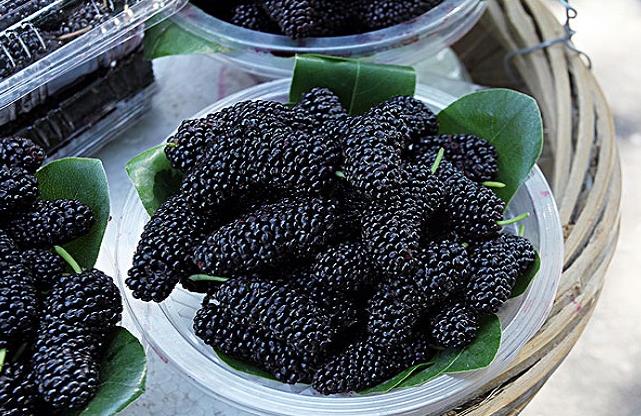
Mulberries, also known as mulberries, are the ears of mulberry trees in the mulberry family. Farmers like to eat their ripe fresh fruits, which have a sweet and juicy taste and are one of the fruits that people often eat. Mulberries are harvested from April to June each year when they ripen, removed from impurities, dried or slightly steamed, and consumed in wine. They can also be put into the mulberry juice production line of the factory. The specific maturity time varies from place to place, with the south being earlier and the north being slightly later. Mature mulberries are oily and have a sweet and sour taste, preferably large, thick, purple red in color, and abundant in sugar.
nutritive value
The main nutritional components of mulberry juice include water, sugar, crude protein, ash, crude fiber, free acid, soluble nitrogen free substances, etc. In addition, the juice of mulberry also contains Essential amino acid and easily absorbed polysaccharides, rich vitamins, red pigments, and minerals such as calcium, iron, zinc, selenium that the human body lacks, which can enhance immunity, promote the growth of hematopoietic cells, and promote metabolism, It has rich nutritional value and certain pharmacological value. Therefore, maximizing the preservation of mulberry nutrition is crucial for the production line of mulberry juice.
Healthcare value
Mulberries were first recorded as medicine in the Tang Dynasty's "Tang Materia Medica". Traditional Chinese medicine believes that mulberry has a sweet and cold taste, enters the heart, liver, and kidney meridians, and has the effect of nourishing yin and nourishing blood. It can also treat yin deficiency, lack of fluids, and insomnia. According to many classical Chinese medicine literature records, it has the effects of promoting the joints of the five organs, promoting blood and qi circulation, calming the soul and calming the mind, reducing blood pressure and thirst, making the eyes bright, turning white and not aging, and relieving alcohol poisoning. Modern medical clinical proof: Mulberries have good nourishing effects on the heart, liver, and kidneys, as well as nourishing blood and dispelling wind. It has significant effects on reducing blood fat and alleviating Neurasthenia, Arteriosclerosis, sexual weakness, deafness and blindness, early whitening of hair and beard, internal heat and thirst, blood deficiency constipation, rheumatic joint pain. The experiment of the research team led by John Pejotto in the United States found that mulberry contains the anti-tumor substance Resveratrol, which has anti-cancer effect. Pharmacological studies have shown that mulberry entering the stomach can supplement the deficiency of gastric juice, promote digestion of gastric juice, promote intestinal secretion, and enhance gastrointestinal peristalsis, thus having the function of tonifying and strengthening. The medicinal value of mulberry is the future expansion path of the mulberry juice production line.
Processing and Application of Mulberry Juice Production Line
(1) Mulberry juice
Mulberry juice can be simply divided into mulberry raw juice and blended juice. Mulberry juice is made by directly pressing fresh mulberry fruits or pressing dried fruits after rehydration. The taste of mulberry juice is relatively light, and related products have not been found on the market. Mulberry blended juice is made from raw mulberry juice by adding sweeteners, essence and other ingredients. Due to its health concept, it is highly praised by many consumers, but its price is high, and it is only sold in some parts of China.
(2) Mulberry wine
Mulberry wine is made from fresh mulberry fruits or juice through fermentation, presenting a ruby red color with a mellow aroma and a unique taste of mulberry. After drinking, it gives a lingering aftertaste. Mulberry wine is an emerging fruit wine that can be consumed by both men and women, meeting the needs of modern beverage development.
(3) Mulberry fruit vinegar
Mulberry fruit vinegar is a type of fruit vinegar beverage made from mulberry as the main raw material, which is blended or fermented. It can be divided into blended and fermented types. The fermented mulberry fruit vinegar is made from mulberry juice as the raw material by fermentation. Blended mulberry fruit vinegar is made by mixing mulberry juice and vinegar in a certain proportion, then adding sucrose, honey, essence and other ingredients.
Development of Mulberry Juice Market in China
From the sales situation of medicinal and food homologous categories through the Taobao Tmall channel, the proportion of mulberry sales in the entire medicinal and food homologous category is still very small, only about 0.5%, and there is still significant room for growth.
Mulberries can be processed into canned fruits, juice, wine, tea, and other products for domestic and international sales in industry. In addition, it can also be added to yogurt as a beverage, with a wide range of applications. Frozen fruits and processed products are exported to the market, so the planting prospects of mulberry are very broad.
Mulberry seedlings are priced according to different specifications, varieties, origins, and markets, with significant price differences. The market price is around 2-5 yuan per seedling. According to relevant data, the market price of mulberry is still rising, and there is a significant difference between the prices of green and black mulberry in the market. The price of black mulberry is around 10-20 yuan, while the price of green mulberry is around 30-35 yuan. It is obvious that the price of wet mulberry is higher, with the market price around 35-40 yuan. According to the above data, the price of mulberry is relatively high, which also indicates that the economic benefits of planting mulberry are still good. With the increase of people's income and the continuous improvement of their living standards, they also pay more attention to health and maintenance, because eating mulberry has various benefits for the body, and thus the demand for mulberry continues to increase. The climate in China is more suitable for planting mulberry, and its production has significantly increased. Currently, the market for mulberry is still in short supply.
The mulberry demand market will maintain growth in the next 10 years, and mulberry products with the same medicinal and food sources will quickly enter the tea tables of thousands of households like raisins, bringing broad market growth space.